The Return to Unity
The deepest journey does not move outward at all — it moves inward, toward remembrance, integration, and unity. The Monad does not seek escape from the body; it seeks fulfillment through embodiment.
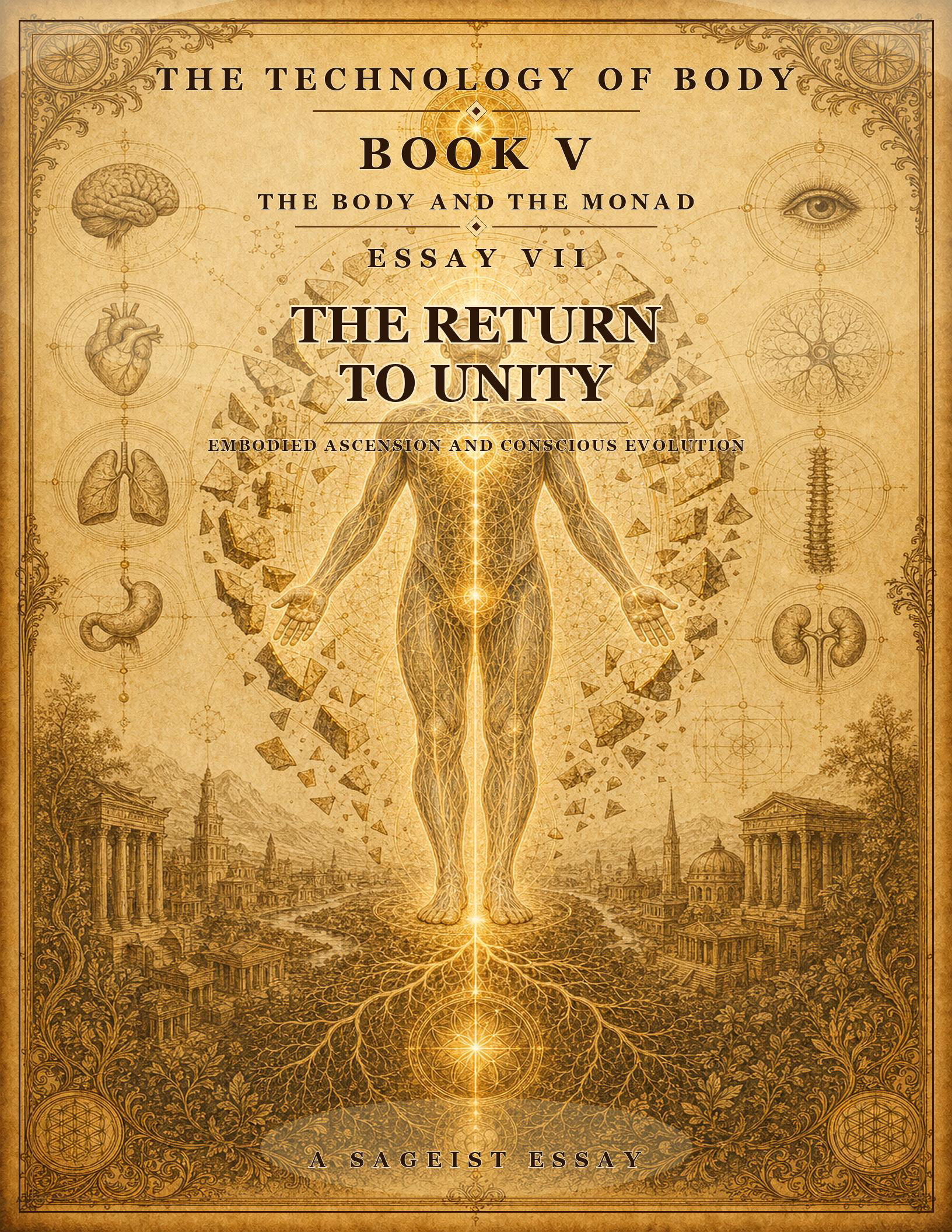
Human beings spend much of life searching outward. For identity. For success. For belonging. For purpose. For truth. The search is not wrong. The world is a field of instruction, and the human being must move through it. Yet the deepest journey may not move outward at all. It moves inward, toward remembrance, integration, and unity.
The Monad represents indivisible consciousness. It is the center beneath role, wound, achievement, memory, appetite, and social identity. Yet life often produces fragmentation. Trauma divides identity. Fear divides perception. Culture divides meaning. Technology divides attention. Desire divides will. Shame divides the body from the self. The modern human becomes internally scattered.
The purpose of embodiment is not merely survival. It is reunification. The body serves as the field where fragmented consciousness becomes whole again. Healing becomes reunification. Wisdom becomes reunification. Initiation becomes reunification. Evolution becomes reunification. The path is not an escape from form, but the restoration of order within form.
This is the secret architecture of Book V. Essay I revealed the Monad as the center inhabiting the body. Essay II revealed incarnation as the descent into form. Essay III revealed memory beyond ordinary memory. Essay IV revealed the body as mirror of consciousness. Essay V revealed the illusion of separation. Essay VI revealed embodiment as evolutionary design. Essay VII now gathers these currents into one recognition: the human being is called to return to unity.
Unity is not sameness. Unity is not the erasure of difference. Unity is not the collapse of body into spirit, individual into collective, matter into abstraction, or personality into silence. True unity is ordered relationship. It is the many brought into coherence around the center. It is the body, psyche, symbol, soul, and civilization remembering their common axis.
The fragmented human lives as a broken council. One part seeks love. Another fears intimacy. One part desires discipline. Another seeks escape. One part speaks truth. Another manages image. One part longs for transcendence. Another clings to appetite. Without a center, these parts compete for rule. The life becomes a sequence of contradictions.
The return to unity begins when the Monad is remembered as center. This does not eliminate the parts. It gathers them. Fear becomes information rather than ruler. Desire becomes energy rather than master. Grief becomes depth rather than identity. Anger becomes boundary rather than destruction. Thought becomes instrument rather than prison. The body becomes temple rather than battlefield.
The body is essential because fragmentation is not only conceptual. It becomes physiological. Trauma changes breath. Fear changes posture. Shame changes muscle. Technology changes attention. Culture changes appetite. Isolation changes chemistry. The divided life becomes a divided organism. Reunification must therefore reach the body.
Healing is reunification because healing restores relationship where life became separated. A frozen memory reconnects with feeling. A silenced voice reconnects with truth. A guarded heart reconnects with trust. A collapsed spine reconnects with dignity. A scattered attention reconnects with presence. A wounded body reconnects with care.
Wisdom is reunification because wisdom sees relationships among things. It does not isolate knowledge from consequence. It does not separate power from ethics, technology from soul, economics from ecology, or spirituality from conduct. Wisdom is intelligence made whole. It perceives the hidden architecture connecting inner life and outer systems.
Initiation is reunification because initiation reorganizes the human being around a deeper center. It breaks identification with the false self and restores allegiance to the real. Breath, ritual, silence, fasting, movement, service, grief, and discipline all become means by which the scattered self is called back into order.
Evolution is reunification because development moves from fragmentation toward coherence. The child begins dependent and unintegrated. The adolescent struggles with identity. The adult must gather role, desire, work, love, power, memory, and mortality into a meaningful life. The future human must gather biology, technology, spirit, ecology, and civilization into one integrated intelligence.
The future of humanity depends not simply upon technological advancement. It depends upon integration. A civilization can possess immense tools while remaining inwardly divided. It can connect the world digitally while fragmenting attention. It can expand knowledge while losing wisdom. It can increase power while diminishing soul. Such advancement is incomplete.
Science must reunite with philosophy. Science without philosophy can measure reality while forgetting meaning. Philosophy without science can speak of reality while avoiding disciplined observation. Together they become more whole: precision joined to wisdom, evidence joined to purpose, method joined to wonder.
Technology must reunite with ethics. Technology without ethics magnifies appetite, fear, vanity, surveillance, and distraction. Ethics without technological literacy becomes powerless before the systems shaping human behavior. Together they create tools that serve the development of integrated humans rather than exploit fragmentation.
Mind must reunite with body. A mind separated from the body becomes abstract, anxious, and dislocated. A body separated from mind becomes impulsive, neglected, or objectified. Together they become embodied intelligence. Thought learns to listen to sensation. Sensation learns to be guided by wisdom. The human being becomes more present.
Spirit must reunite with matter. Spirit without matter becomes escape. Matter without spirit becomes mechanism. Together they reveal incarnation. The invisible becomes visible. The sacred enters daily life. The body becomes a vessel. Food, breath, work, touch, architecture, and community become places where consciousness remembers itself.
The human being must reunite with itself. This is the heart of the doctrine. The divided self cannot build a coherent civilization. Fragmented leaders build fragmented institutions. Dysregulated populations build anxious politics. Disembodied intelligence builds disembodied technology. A society becomes the enlarged image of its inner condition.
The return to unity is therefore both personal and civilizational. The person must gather body, mind, emotion, shadow, memory, desire, attention, and spirit. The civilization must gather education, medicine, economics, technology, ecology, art, governance, and ritual. The same law operates at different scales: what is divided must be brought into right relationship.
The body offers the model. Health is not the domination of one system over all others. Health is coherence among differentiated systems. The heart does not become the lungs. The lungs do not become the gut. The nervous system does not become the blood. Each remains itself, yet all cooperate. The body is unity through relationship.
This model must guide civilization. A healthy culture does not erase difference. It coordinates difference toward life. The artist, scientist, builder, healer, teacher, farmer, technologist, parent, elder, and leader each serve distinct functions. Civilization becomes sacred when these functions participate in a shared field of meaning.
The illusion of separation produced suffering because it taught parts to forget the whole. The return to unity heals suffering by restoring belonging. The body belongs to earth. The mind belongs to truth. Emotion belongs to relationship. Technology belongs to wisdom. Power belongs to service. The individual belongs to the living field without losing the sacred center.
This is not easy. Fragmentation has momentum. Trauma repeats. Systems defend themselves. Markets profit from division. Technologies capture attention. Cultures preserve inherited wounds. The return to unity requires discipline, courage, design, ritual, education, and love. Unity must be practiced, not merely proclaimed.
The first practice is attention. What is scattered must be gathered. The person begins by returning attention to breath, posture, sensation, thought, emotion, and environment. This return is simple, but not small. Attention is the cord by which consciousness gathers itself from dispersion.
The second practice is truth. Unity cannot be built upon denial. The person must tell the truth about fear, wound, desire, exhaustion, resentment, longing, and love. Civilization must tell the truth about extraction, loneliness, overstimulation, ecological damage, institutional mistrust, and spiritual hunger. False unity hides conflict. True unity integrates truth.
The third practice is rhythm. The body requires rhythm to become coherent. Breath, sleep, food, movement, work, silence, and relationship must find living order. A civilization also needs rhythm: seasons, rituals, rest, celebration, mourning, apprenticeship, renewal, and shared symbols. Rhythm is how unity becomes time.
The fourth practice is repair. Fragmentation creates injury. Injury requires repair. Apology, boundary, restitution, mourning, dialogue, therapy, redesign, and justice become sacred technologies of reunification. A culture that cannot repair will repeat its wounds. A person who cannot repair will remain divided.
The fifth practice is devotion. Unity requires allegiance to something deeper than convenience. The Monad must be served. Truth must be served. Life must be served. Beauty must be served. The future must be served. Devotion gives direction to integration. Without devotion, the parts scatter again.
The sixth practice is embodiment. Unity must be brought into breath, posture, speech, appetite, labor, rest, and relationship or it remains decorative. The seventh practice is design. Homes, schools, technologies, calendars, cities, rituals, and institutions either help the human being remember wholeness or train fragmentation. The eighth practice is service. Wholeness is not hoarded. It is transmitted.
Together these practices form a path of return. Attention gathers the scattered self. Truth reveals what has been divided. Rhythm stabilizes the organism. Repair restores broken relationship. Devotion gives direction. Embodiment makes unity real. Design extends unity into the world. Service returns the fruit to life.
The modern human faces a strange destiny. Information expands while attention fractures. The individual becomes publicly visible and privately disoriented. The body is measured, displayed, modified, stimulated, and neglected at once. The return to unity is no longer optional spiritual refinement. It is civilizational necessity.
This is why the body must lead the return. The body reveals what culture denies. It grows anxious under false speed, inflamed under excess, numb under violation, tired under meaningless labor, and restless under disembodied technology. It grows stronger under rhythm, truth, nourishment, movement, beauty, and belonging.
The body becomes the compass back to unity. Not because every bodily signal is automatically wise, but because the body remains in conversation with reality. It cannot live on abstraction alone. It asks for breath, food, touch, rest, movement, sunlight, water, trust, and purpose. It asks consciousness to remember the living field.
The Monad needs this compass. Without the body, the mind can invent endless philosophies of unity while living divided. It can speak of love while avoiding intimacy. It can speak of truth while fearing the throat. It can speak of transcendence while neglecting sleep. It can speak of service while abandoning the nervous system. The body brings the doctrine back to earth.
Earth is not a prison for the Monad. Earth is the place where unity becomes tested through matter. The body belongs to earth, and the Monad learns through this belonging. The lungs teach atmosphere. The bones teach mineral. The blood teaches water. The metabolism teaches fire. The senses teach world. The skin teaches boundary. The heart teaches circulation. The spine teaches ascent.
The return to unity is therefore ecological. A human being cannot become whole while imagining nature as external. The body is nature organized as person. To poison the earth is to poison the body. To degrade food is to degrade consciousness. To destroy the living field is to attack the conditions of incarnation. Ecology is not outside spirituality. Ecology is the body expanded.
The return to unity is also relational. A person cannot become whole while treating others as instruments, enemies, consumers, projections, or extensions of the self. Relationship reveals whether unity has matured beyond concept. The other person is another center of experience. Love begins when the Monad recognizes the mystery of another Monad.
This recognition changes ethics. To harm another is not merely to violate a rule. It is to damage the field in which consciousness is learning itself. To deceive another is to fracture shared reality. To exploit another is to deny the sacred center within them. To love another is to help create conditions where unity can be remembered.
The return to unity is also political in the deepest sense. Politics is not merely competition for power. It is the organization of collective life. If the human being is fragmented, politics becomes a theater of fear, appetite, resentment, and control. If the human being becomes more integrated, politics can become coordination in service of life.
The doctrine does not naively expect systems to heal themselves through sentiment. Structures matter. Laws matter. Economics matter. Power matters. But structures built by fragmented consciousness reproduce fragmentation. Therefore the Sageist works on both levels: inner governance and outer governance, self-order and system-order, personal coherence and civilizational design.
The return to unity is educational, medical, technological, architectural, economic, artistic, and ritual. Education must cultivate whole humans. Medicine must treat the body without forgetting the inhabitant. Technology must serve development rather than capture attention. Architecture must help the nervous system remember order. Economics must support life instead of abstract appetite. Art must gather fragments into symbol. Ritual must give unity a container in time.
These are not separate projects. They are expressions of one return. Body, psyche, society, technology, ecology, architecture, economics, art, and ritual belong to the same field. When treated separately, civilization fragments. When brought into relation, civilization begins to remember its soul.
Book I revealed the body as the original technology. Before civilization built communication networks, circulation systems, defense systems, symbolic systems, and governance structures, the body had already organized them in living form. Civilization did not invent intelligence. It externalized bodily intelligence.
Book II revealed the nervous system as the operating system of consciousness. Reality is experienced through the state of the observer. A dysregulated nervous system sees threat everywhere. A regulated nervous system can perceive possibility. The future of civilization depends upon nervous system literacy.
Book III revealed symbolic physiology hidden within the body. Organs are not only functions. They are archetypes. The spine is axis. The heart is throne. The breath is bridge. The voice is invisible architecture. The body is not mute matter. It is the psyche's nearest alphabet.
Book IV revealed initiation as the technology of transformation. Information educates, but initiation reorganizes being. Breath, fasting, ritual, movement, silence, and attention become methods by which consciousness enters the body more fully. The initiate does not merely learn. The initiate becomes.
Book V reveals the deepest truth of this sequence. The body is not merely biological existence. It is the sacred vessel through which consciousness enters reality, evolves through experience, and gradually remembers original unity. The Monad does not seek escape from the body. The Monad seeks fulfillment through embodiment.
This fulfillment is not indulgence. It is not mere pleasure, comfort, identity, or self-expression. Fulfillment means that the Monad becomes increasingly transparent through the body. Breath carries presence. Speech carries truth. Gesture carries dignity. Work carries service. Love carries responsibility. Power carries wisdom. The invisible becomes trustworthy in form.
The return to unity also changes the meaning of ascension. Ascension is not abandonment of the lower. It is the integration of the whole. The root is not rejected by the crown. The body is not rejected by spirit. Earth is not rejected by heaven. Instinct is not rejected by wisdom. The human being rises by bringing all levels into coherent relation.
The spine symbolizes this law. It stands between earth and sky. It carries the nervous system. It holds memory, posture, and ascent. It teaches that vertical consciousness must remain rooted. The human being is not meant to escape the world as vapor. The human being is meant to stand as bridge.
The heart symbolizes the same. It circulates life among parts. It receives and sends. It contracts and expands. It mediates between center and periphery. A closed heart fragments the organism. A coherent heart participates in unity. Symbolically, the heart is the civilizational organ of integration.
The breath completes the triad. It proves that the self is never sealed. Inhalation receives the world. Exhalation returns to it. Breath is the ritual of interdependence repeated from birth until death. The person who breathes consciously remembers unity through the simplest act of life.
The gut adds discernment. Unity is not indiscriminate openness; the organism must receive what nourishes and release what harms. The hands add service. They build, repair, protect, feed, write, bless, cultivate, and hold. The voice adds truth. It carries inner reality into the shared field. The eyes add presence. They reveal whether the world is being consumed, avoided, judged, or met.
In this way the whole body becomes a liturgy of unity. Spine, heart, breath, gut, hands, voice, and eyes each participate in reunification. The body is not merely the place where unity is discussed. It is the instrument through which unity is practiced.
The future human will be recognized by integration. Not by spectacle, not by dominance, not by technological enhancement alone, not by spiritual language alone. The future human will be more coherent: body regulated, mind clear, heart alive, shadow integrated, power disciplined, attention sovereign, relationship sacred, technology ethical, and presence transmissive.
Such a human becomes a seed of future civilization. Their home becomes different. Their work becomes different. Their leadership becomes different. Their relationship to the earth becomes different. Their use of technology becomes different. The integrated human does not merely believe in a new world. The integrated human begins to embody it.
Civilization begins again wherever a human being becomes whole. This is not romantic exaggeration. Every institution is built by bodies. Every policy passes through nervous systems. Every technology reflects values. Every culture is transmitted through attention, memory, and behavior. The whole world changes through the kind of humans who build it.
The return to unity therefore requires both inner work and outer design. Meditation without institution-building remains incomplete. Institution-building without inner work reproduces fragmentation. The Sageist builds inwardly before building outwardly, then builds outwardly as an expression of inward order. This is the architecture of responsible evolution.
The doctrine does not promise a world without suffering. It points toward a way of metabolizing suffering into wisdom. It does not promise a self without difference. It points toward a center capable of holding difference. It does not promise escape from the body. It reveals the body as the place where consciousness becomes whole.
The Monad remembers through embodiment. It descends, fragments, learns, suffers, loves, disciplines, creates, heals, integrates, and returns. But the return is not a retreat from the world. It is a deeper participation in the world from the place of unity. The one who returns does not disappear. The one who returns becomes more present.
Essay VII closes Book V with a final recognition: through embodiment, consciousness remembers what it has always been. Whole. Not untouched by experience, but deepened through it. Not separate from matter, but fulfilled through form. Not isolated from life, but reunited with the living field.
The gate closes here: the Monad does not seek escape from the body. The Monad seeks fulfillment through embodiment. The body is the sacred vessel through which consciousness enters reality, evolves through experience, and remembers original unity. The journey outward was real. The return inward is the initiation. The human being becomes whole when the body, psyche, symbol, soul, and civilization remember the same center.